Solus Grid
Solus Grid is a single-player (or multiplayer pass-and-play) strategy game about running a power company. You run a power company: you bid for power plants, buy fuel, build districts and try to power more of them than your rivals.
Features
- The rules — Power plant auctions, a fuel market, district building, Stages 1–3, end-game scoring, and the 2-player “Against the Consortium” variant.
- Two visual styles — Retro-futurist (default) or the Classic dark look, chosen on the New Game screen.
- Two plant decks — the Base-Set, or Hydro & Geothermal with extra renewables (pick it on the New Game screen).
- Three maps — Germany, USA and a Sci-fi Galaxy.
- 1 to 6 players — including human (turn-based) or computer opponents.
- Five AI personalities — from a forgiving Rookie to a ruthless Mastermind.
- Click any power plant card for a pop-out card with its details and a short “technology story”.
- Save and resume — automatic autosave, plus save/load to a file (JSON).
- Smooth map — mouse-wheel zoom, drag to pan, pinch on touch screens.
How to play
The goal
Power more districts than anyone else when the game ends.
You do that by owning power plants (which decide how many districts you can power), by buying fuel (which lets the plants run) and by building districts in cities on the map. Powered districts earn you money every round, and money buys more plants, fuel and cities.
Building lots of districts is not enough — the winner is whoever can power the most, not whoever owns the most.
⚠️ Suggestion ⚠️:
Learn by Playing is more fun!
The Game will guide you on your decisions. If you like reading (a lot!) the detailed instructions/rules are described below.
Setting up a game
On the New Game screen:
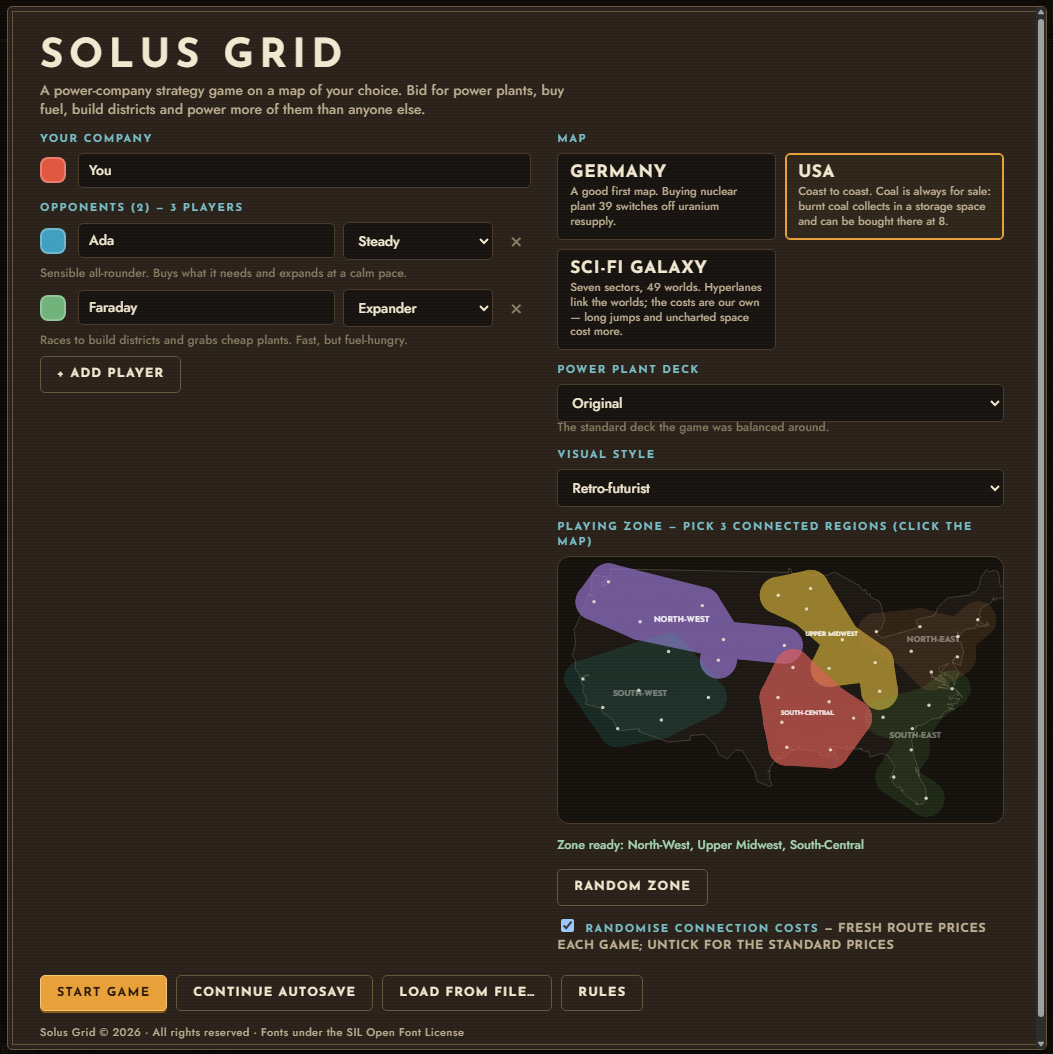
- Your company — type a name and click the colour square to change colour.
- Opponents — add 1 to 5 and pick a personality for each (see AI opponents).
- Choose Map — Germany, USA or Sci-fi Galaxy (others coming soon).
- Playing zone — the map is split into coloured regions and you play on a connected group of them. The number of regions depends on how many players there are (the game tells you how many to pick). Click regions to change the zone, or press Random zone.
- Randomise connection costs is ticked by default: every route price on the map is scaled to 50–150% of its standard value, so each game has a different cheapest side. Untick it to play with the standard prices.
- Choose a Power plant deck: Base-set (the standard set) or Hydro & Geothermal (same card numbers and similar prices, with hydro and geothermal renewables in place of a few fuel burners).
- Press Start game.
Everyone starts with $50 money (the gold $ coin) and no plants, fuel or districts. The starting player order is random.
How to read the screen
| Where | What you see |
|---|---|
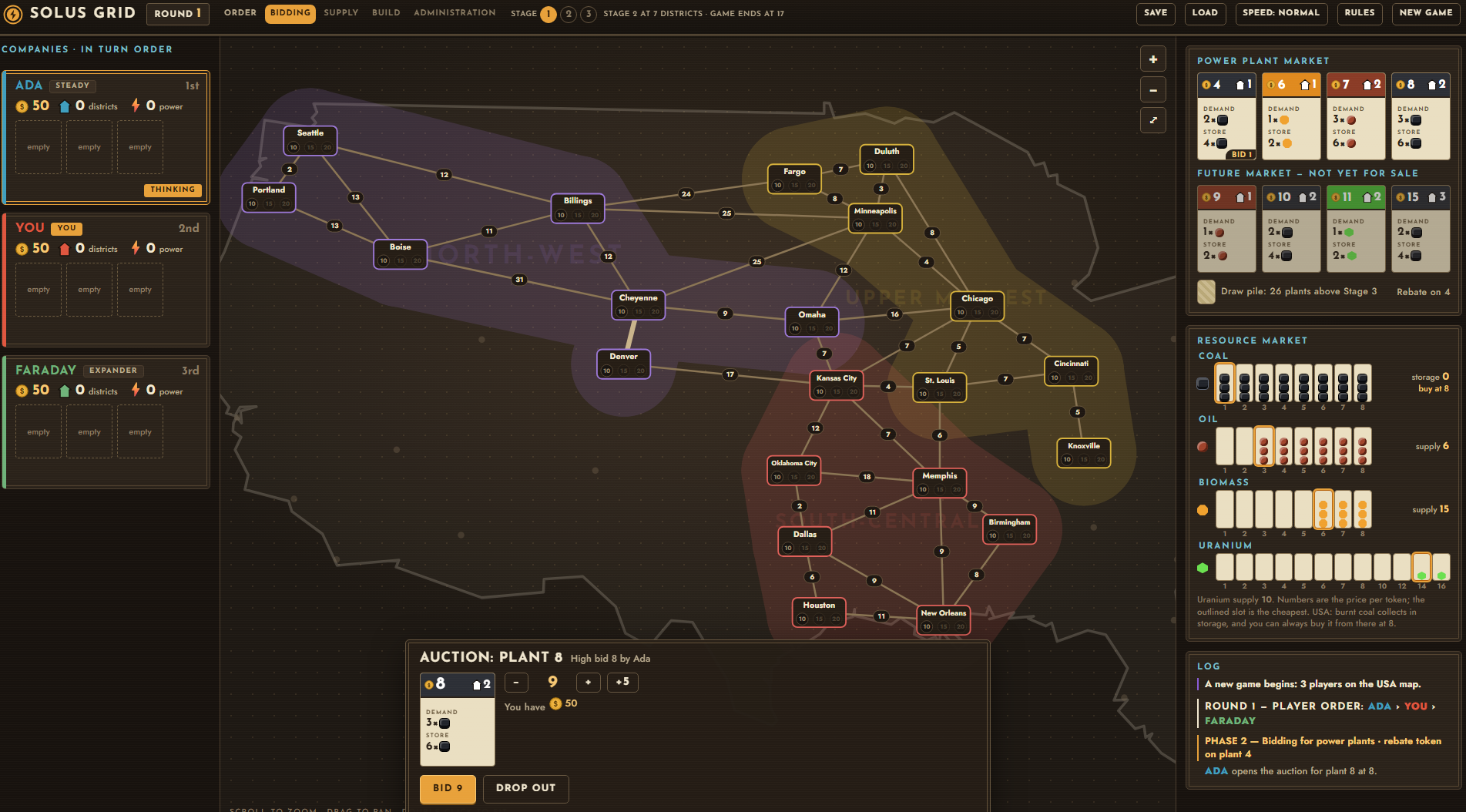
| Top bar | Round number, the five phases (current one highlighted), which Stage the game is in, plus Save, Load, Speed, Rules and New game buttons. |
| Left panel | Every company in turn order: money, districts owned, total power of its plants, its plants (with the fuel stored on them) and its fuel. |
| Centre | The map. Scroll to zoom, drag to pan, double-click to fit. Coloured markers show who has built in each city. |
| Right panel | The power plant market, the resource (fuel) market and the game log (bottom right). |
| Bottom box | Your turn: whatever you need to decide right now, with its buttons. When it is not your turn it shows who is thinking. |
Reading a power plant card
| $ 20 ⌂ 5 | $ number = the plant's number, which is also its minimum bid cost. Power number = how many districts it can power. |
| DEMAND 3× | How much fuel the plant burns each round it runs to power districts. |
| STORE 6× | How much fuel it can hold (always 2x its demand). |
- Coal / Oil / Biomass / Uranium plants use that fuel. Hybrid plants burn either coal or oil (any mix).
- Renewable plants (leaf symbol) and the Fusion plant need no fuel — they always run for free.
- Click any card to pop it out and see all its details, its efficiency and a short story about its technology. Older, cheaper plants use older technology; newer, pricier plants are more efficient.
One round is made up of five phases
Every round runs through the same five phases. The game moves along by itself and asks you to decide only when it is your turn.
1. Order (automatic)
- Whoever owns the most districts plays first. A tie goes to the owner of the highest-numbered (costly) plant.
- Round 1 starts in random order.
- Bidding follows this order. Supply and Build follow it backwards, so trailing players get first pick of fuel and the best building spots.
2. Bidding
Only the current market can be bought (the four lowest-numbered plants; six in Stage 3). The future market just shows what comes next.
- On your turn, pass or open an auction: click a plant, press Select for auction, enter your first bid and press Start auction.
- A first bid is never below the plant's number. The lowest plant carries a rebate token, so its first bid can be as low as 1 (cheaper).
- The other players in the phase then raise the bid or drop out. Nobody can bid more than their money.
- The highest bidder pays the bank and keeps the plant. They are done for this phase.
- If you opened an auction and someone outbid you, you may try again with another plant, or pass.
- Each sold plant is replaced by a fresh one from the deck.
- Passing takes you out of the phase for this round.
- In round 1 everyone has to buy a plant.
Limits:
- You can hold up to 3 plants. To buy a fourth, scrap one you already owned; fuel that no longer fits returns to the supply.
- If the rebate (discount) plant finds no buyer, it is discarded and replaced.
3. Supply
The last player in order goes first.
- There are four fuels: coal, oil, biomass and uranium. Each sits in numbered slots, and the slot number is the price of a unit.
- Cheaper units always go first, so buying pushes the price up.
- Set an amount with + / − for each fuel and press Buy. Suggest fuel for my districts picks a sensible amount for you.
- You can only buy what you can afford and have room for. A plant holds twice its demand, and hybrid plants split their room between coal and oil.
- Fuel you don't burn stays on your plants for later.
4. Build
Again the last player goes first.
- Click a glowing city on the map to build a district there. Hovering shows the cheapest route and its price.
- The price is route + city space:
- Route — the cheapest chain of links (the numbers on the lines) back to a city where you already have a district. Passing through rivals' cities is fine. Your first district has no route cost.
- City space — $10 for the first company to build a district in a city, $15 for the second, $20 for the third (see Stages section).
- You can build in several cities in one turn, but only one district per city.
- Press Build. Click the last chosen city again, or press Undo last, to take it back.
Tip: districts your plants cannot power earn nothing, so build roughly what you can run.
5. Administration
- Power districts (in turn order). Pick the plants to run, or press Power … districts. Each one burns its demand and can supply its listed number of districts. You power the lower of your district count and your running plants' total capacity.
- You are paid for the districts you powered (see the income table). Burnt fuel returns to the supply.
- Restock fuel: new tokens, based on the player count and the Stage, fill the priciest empty slots first.
- Refresh plants: in Stages 1 and 2 the most expensive plant on the market goes to the bottom of the deck and a new one is drawn. In Stage 3 the cheapest plant is removed and a new one is drawn.
Then the next round starts.
The three stages
The game grows as it goes.
| Stage | Begins | Effect |
|---|---|---|
| 1 | At the start | One district per city. Building costs $10. |
| 2 | During Administration, once any company owns 7 districts (6 with six players) | The cheapest plant is discarded. A city takes a second district, at $15. |
| 3 | When the Stage 3 card comes up in the plant deck | The future market is gone and all 6 plants are for sale. A city takes a third district, at $20. |
How the game ends
- When a company reaches the final district count (see the reference table; 17 with three or four players), the game finishes at the end of that round.
- In that last Administration nobody is paid. Each company just counts the districts it can power.
- Most powered districts wins. Ties go to the most money, then the most districts.
Two (human) players: the Consortium
With just one opponent the game adds an automatic third company, the Consortium, so the map stays contested.
How the Consortium works
- Setup: before round 1, six Consortium markers are placed. The starting player places 1, the other player 2, the starting player 2 more, then the other player 1. Every marker after the first must touch a city the Consortium already holds. Those cities stay closed until Stage 2.
- Order: the Consortium always plays second.
- Plants: after the first player's auction turn it takes the most expensive plant on the market for free. If it already owns 3 plants, it only swaps up to a higher-numbered one.
- Fuel: in the Supply phase it takes the fuel its plants need for free and returns it at round end.
- Markers: whenever a player builds in a new, empty city, the Consortium claims that city's second (15) space while it has markers left (16 in total). That space stays blocked until Stage 3.
- It cannot win ⚠️, earns no money and never triggers Stage 2. A 2-player game ends at 18 districts.
Map-specific rules
- Germany: when a company buys plant #47 (the nuclear plant), uranium is no longer resupplied for the rest of the game (mimicking the German nuclear phase-out).
- USA: burnt coal collects in a storage space; when the market has no coal left you can always buy from storage at $8 each.
- Sci-fi Galaxy: no special rules (maybe some coming soon!?).
Reference tables
| Districts powered | 0 | 1 | 2 | 3 | 4 | 5 | 6 | 7 | 8 | 9 | 10 |
|---|---|---|---|---|---|---|---|---|---|---|---|
| Income | $11 | $23 | $34 | $45 | $56 | $66 | $75 | $84 | $93 | $101 | $108 |
| Districts powered | 11 | 12 | 13 | 14 | 15 | 16 | 17 | 18 | 19 | 20+ |
|---|---|---|---|---|---|---|---|---|---|---|
| Income | $115 | $122 | $128 | $133 | $138 | $143 | $147 | $150 | $153 | $156 |
Zone size, Stage 2 and end of the game
| Players | Regions in the zone | Stage 2 starts at | Game ends at |
|---|---|---|---|
| 2 (with the Consortium) | 3 | 7 districts | 18 districts |
| 3 | 3 | 7 districts | 17 districts |
| 4 | 4 | 7 districts | 17 districts |
| 5 | 5 | 7 districts | 15 districts |
| 6 | 5 | 6 districts | 14 districts |
Fuel resupply each round (coal / oil / biomass / uranium)
| Players | Stage 1 | Stage 2 | Stage 3 |
|---|---|---|---|
| 2 | 3 / 2 / 1 / 1 | 4 / 2 / 2 / 1 | 3 / 4 / 3 / 1 |
| 3 | 4 / 2 / 1 / 1 | 5 / 3 / 2 / 1 | 3 / 4 / 3 / 1 |
| 4 | 5 / 3 / 2 / 1 | 6 / 4 / 3 / 2 | 4 / 5 / 4 / 2 |
| 5 | 5 / 4 / 3 / 2 | 7 / 5 / 3 / 3 | 5 / 6 / 5 / 2 |
| 6 | 7 / 5 / 3 / 3 | 9 / 6 / 5 / 3 | 6 / 7 / 7 / 3 |
Fuel slots: coal, oil and biomass have slots 1–8 (3 tokens each); uranium has slots 1–8, 10, 12, 14, 16 (1 unit each). Units only come back to the market from the supply — burnt fuel returns to the supply, so a fuel can run dry.
Five tips for your first game
- Round 1: take a cheap plant whose fuel is plentiful — you have to buy something anyway.
- Match plants to districts. A plant that can power 5 is wasted if you only own 3, and a district with no plant behind it earns nothing.
- Money wins games. Don't overpay in auctions if it leaves you unable to build and buy fuel.
- Watch the fuel market. A plant on a scarce fuel is risky; renewable plants never run out.
- Being slightly behind is fine. Last place in turn order buys fuel and builds first.
Maps
| Map | Cities | Regions | About |
|---|---|---|---|
| Germany | 42 | 6 | A good first map: six regions of well-connected German cities. |
| USA | 42 | 6 | Coast to coast, with long, costly links across the middle. Coal is always for sale from storage. |
| Sci-fi Galaxy | 49 | 7 | An original galaxy of worlds linked by hyperlanes; connection costs are invented for gameplay (they grow with distance, and the Uncharted Regions cost extra). |
AI opponents
Each opponent uses the same brain with a different personality. Mix them as you like.
| Personality | Plays like… |
|---|---|
| Rookie | Hasty and inconsistent. Overbids and underbuilds — a friendly first opponent. |
| Steady | A sensible all-rounder. Buys what it needs and expands at a calm pace. |
| Expander | Races to build districts and grabs cheap plants. Fast, but fuel-hungry. |
| Industrialist | Buys big, efficient plants early and stockpiles cheap fuel. Builds late. |
| Mastermind | Optimises plants, fuel and timing, and plays the end-game to win. |
In simulated 4-player games on the Germany map, Mastermind wins the most, Rookie the least, and the others sit in between.
Development log
- Solus Grid v1.0 is live!13 days ago
Leave a comment
Log in with itch.io to leave a comment.